Voices from Mountain Biosphere Reserves for Glacier Preservation
On Friday 27 June 2025, an inspiring virtual session was held under the International Year of Glacier Preservation 2025, led by the World Network of Mountain Biosphere Reserves. Titled “Glacier Talks”, the event brought together global experts, researchers, and biosphere reserve managers to reflect on the vital role of mountain biosphere reserves in glacier monitoring, research, and conservation.
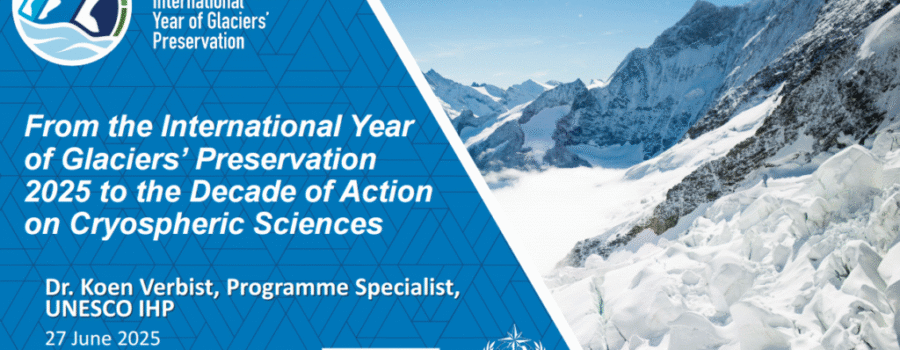
Koen Verbist (UNESCO) opened the session with an overview of the International Year’s five strategic pillars, ranging from awareness-raising to policy support, and introduced the Decade of Action on Cryospheric Sciences (2025–2034), emphasizing the opportunity for mountain biosphere reserves to lead on-the-ground adaptation efforts.
Samuel Nussbaumer (World Glacier Monitoring Service) followed with a compelling presentation on the global retreat of glaciers, positioning them as both symbols of climate change and indicators of our success (or failure) in limiting global warming. His data revealed that while many glaciers are doomed, decisive climate action can still preserve up to half of current glacial volume.
Yang Wei (Institute of Tibetan Plateau Research, Chinese Academy of Sciences) shared insights on glacier monitoring in the Southeastern Tibetan Plateau, highlighting scientific efforts in one of the planet’s most sensitive cryospheric regions.
Felipe Ugalde (University of Chile) addressed the growing threats posed by glacier hazards, such as glacial lake outburst floods (GLOFs) and the importance of risk assessment and early warning systems in glacier regions.
Marc Pons (University of Saskatchewan) presented early results from an analysis of glacier coverage across the World Network of Biosphere Reserves. A total of 64 mountain biosphere reserves with active glaciers were identified, covering more than 80,000 km². He emphasized the role of biosphere reserves not only in protecting glacier ecosystems but also in advancing long-term monitoring and conservation.
Finally, Abdías Villoslada Taipe (Huascarán Biosphere Reserve) and Paola Moschella Miloslavich (INAIGEM) shared experiences from Peru, showcasing glacier monitoring initiatives in the Andes that connect high-altitude ecosystems with local livelihoods, spiritual values, and traditional knowledge.
Here is a link with the presentations.
For more information about the International Year of Glacier Preservation: https://www.un-glaciers.org